
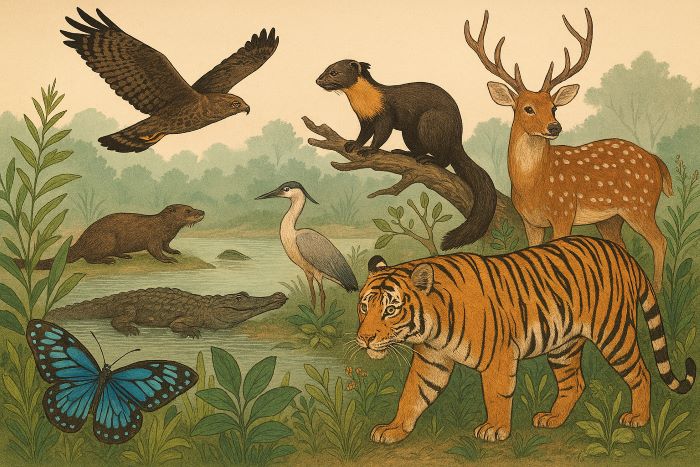
When people think of Jim Corbett National Park, the image that most often comes to mind is that of a majestic Bengal tiger emerging silently from tall grass. Tigers are undoubtedly the icons of Corbett, drawing wildlife enthusiasts, photographers, and safari lovers from across the world, each hoping for that magical glimpse of India’s most celebrated predator.
Yet, to experience Corbett only through the lens of tigers is to see just one chapter of a much larger story.
Jim Corbett National Park is not merely a tiger reserve; it is a living, breathing ecosystem where every form of life big and small plays a vital role. Spread across riverbanks, dense sal forests, open grasslands, and hilly terrain, the park is home to an astonishing variety of birds, reptiles, insects, and lesser‑known mammals. Together, they create one of India’s most biologically rich and balanced landscapes.
For the observant traveler, Corbett reveals itself in subtle ways. In the early mornings, before safaris even begin, the forest resonates with birdsong rather than roars. Colorful kingfishers skim across rivers, eagles soar overhead, and woodpeckers drum rhythmically against tree trunks. Along muddy trails and water edges, reptiles bask silently, while butterflies and insects paint the air with movement and color.
These quieter forms of wildlife often go unnoticed, not because they are rare, but because they require a different way of seeing one that values patience over pursuit and curiosity over expectation. Spotting an otter slipping into the water, watching ants build a trail across the forest floor, or hearing frogs call at dusk can be just as memorable as a tiger sighting.
Beyond the roar of the tiger lies a world that teaches balance, coexistence, and interdependence. This hidden side of Corbett helps visitors understand that conservation is not about protecting one species alone, but about preserving an entire web of life.
By slowing down and widening one’s lens, travelers can discover that Jim Corbett National Park isn’t just a destination for tiger seekers it’s a place where nature tells countless stories, waiting quietly for those willing to notice.
A Paradise for Birdwatchers
With over 600 recorded bird species, Jim Corbett National Park stands proudly among India’s finest birding destinations. What makes birdwatching in Corbett truly special is the park’s remarkable diversity of habitats. From the riverbanks of the Ramganga, dense sal forests, and open grasslands to serene wetlands, each landscape supports a unique mix of resident and migratory birds throughout the year.
For travelers who start their safaris early, Corbett offers a magical experience. As the forest slowly wakes up, the air fills with layered birdsong calls echoing from treetops, river edges, and forest floors. These early morning hours are ideal for birding, as many species are most active before the sun rises high.
Perched high on branches, you may spot the crested serpent eagle, patiently scanning the ground for prey. Nearby, the sharp and familiar call of the red junglefowl, believed to be the ancestor of modern domestic chickens, rings through the forest a sound that connects today’s wilderness with ancient history. Along forest tracks and open clearings, birders often encounter woodpeckers, parakeets, and drongos, each adding movement and color to the landscape.
The Ramganga River is especially rewarding for travelers with an interest in water birds. Its banks and shallow stretches attract elegant river lapwings, agile plovers, and the striking white‑throated kingfisher, often seen darting from perches to the water below. Spending a few quiet minutes near the river can reveal a surprising variety of species without needing to venture far.
For those visiting during the winter months, typically from November to February, Corbett transforms into a seasonal refuge for migratory birds. Species such as great cormorants, ruddy shelducks, and various species of wagtails arrive from colder regions, enriching the park’s already impressive avian diversity. Lakes, riverbanks, and open wetlands become vibrant gathering spaces, offering excellent opportunities for photography and observation.
What many travelers don’t realize is that birdwatching in Corbett does not require expert equipment or knowledge. A simple pair of binoculars, patience, and an openness to listening can turn an ordinary safari into a deeply rewarding experience. While tiger sightings may remain unpredictable, birds are constant companions in Corbett visible, audible, and endlessly fascinating.
For anyone willing to look beyond the big cats, Corbett’s birdlife offers moments of calm, discovery, and connection with nature that are often more frequent and just as memorable as the thrill of spotting a tiger.
The Silent World of Reptiles and Amphibians
Reptiles are among the most misunderstood inhabitants of Jim Corbett National Park, often viewed with hesitation or fear by first‑time visitors. Yet, these creatures play a vital role in maintaining the park’s ecological balance, acting as predators, prey, and environmental indicators. For travelers willing to observe without prejudice, Corbett’s reptilian life adds a fascinating and ancient dimension to the forest experience.
The park is home to several notable reptile species, including the critically endangered gharial, mugger crocodiles, monitor lizards, and multiple species of snakes among them the elusive king cobra. Most of these reptiles prefer to remain unseen and avoid human contact, blending naturally into Corbett’s rivers, marshes, forest edges, and grassy clearings.
What Travelers Can Expect to See
Along the riverbanks and wetlands, particularly near the Ramganga River, visitors may spot mugger crocodiles basking motionless in the sun. Their stillness can make them appear like part of the landscape ancient, patient, and perfectly adapted to their surroundings. These sightings are usually from a safe distance during jeep safaris or nature walks accompanied by trained guides.
Gharials, with their long, narrow snouts, are more aquatic and are often seen quietly resting on sandy riverbanks. Their presence is a strong sign of a healthy river ecosystem, something Corbett has worked hard to preserve.
On forest trails and near water bodies, travelers occasionally encounter monitor lizards, large but shy reptiles that disappear swiftly into vegetation when disturbed. While snakes are part of Corbett’s ecosystem, actual sightings during safaris are rare, as most species are nocturnal and highly secretive.
Amphibians: Voices of the Monsoon
During the monsoon season, Corbett’s forest undergoes a dramatic transformation. As rains nourish the land, frogs, toads, and other amphibians emerge in large numbers. At dusk, their callsecho through the forest, creating a natural orchestra that signals the health and vitality of the environment.
For visitors staying overnight near the park, these sounds become a memorable part of the experience proof that wildlife in Corbett continues long after daytime safaris end. Amphibians play a crucial role in controlling insect populations and, in turn, serve as food for birds, reptiles, and mammals higher up the food chain.
Why These Creatures Matter
Though smaller and less celebrated than tigers or elephants, reptiles and amphibians are essential indicators of a healthy ecosystem. Their survival depends on clean water, stable temperatures, and balanced habitats all signs that Corbett’s conservation efforts are working.
Understanding their importance also helps travelers appreciate the park in a more holistic way. Corbett is not a wildlife showcase built around a single species; it is a finely balanced system where even the quietest creatures hold great significance.
A Tip for Travelers
For those curious but cautious, observing reptiles and amphibians in Corbett is best done through guided safaris and naturalist‑led walks, where experts help explain behavior, habitats, and safety. Maintaining distance, following park rules, and respecting wildlife ensures both a safe visit and meaningful encounters.
By learning to appreciate these often‑overlooked species, travelers gain a deeper understanding of Corbett not just as a tiger reserve, but as a living museum of natural history shaped over thousands of years.
Insects: The Hidden Engineers of the Forest
Insects are perhaps the most overlooked residents of Jim Corbett National Park, yet without them, the forest as we know it simply could not survive. Often unnoticed beneath our feet or fluttering briefly past our field of vision, these small creatures perform some of the most important ecological work in the park. From pollination and decomposition to maintaining soil health, insects quietly keep Corbett’s ecosystem functioning.
For travelers who slow down and observe closely, the insect world reveals itself as surprisingly vibrant and full of life.
Butterflies: Living Color in the Forest
One of the easiest ways to notice insect life in Corbett is through its butterflies. Along forest paths, grasslands, and sunlit clearings, butterflies are a constant presence, adding movement and color to the landscape. Species such as the common jezebel, blue tiger, and peacock pansy are frequently seen, especially during warmer months.
Watching butterflies drift from flower to flower is not only visually pleasing but also a reminder of their vital role as pollinators, supporting the park’s rich plant life. For travelers interested in photography or mindful observation, early mornings and late afternoons offer the best opportunities to witness this delicate activity.
Ants, Beetles, and Nature’s Workforce
While butterflies capture attention with beauty, insects like ants, beetles, and termites work quietly behind the scenes. These species are often missed or dismissed, yet they act as natural engineers of the forest. By breaking down fallen leaves, dead wood, and organic waste, they recycle nutrients back into the soil, helping plants grow stronger and healthier.
Termites aerate the soil, improving water absorption, while ants help disperse seeds across the forest floor. For curious travelers, simply pausing near a fallen log or an ant trail can offer insight into how interconnected life in the forest truly is.
Nightfall and the Magic of Fireflies
As daylight fades, Corbett reveals another secret a softer, more magical side. On certain evenings, especially after the monsoon, fireflies appear among trees and bushes. Their blinking lights transform the forest into a dreamlike landscape, creating moments that feel both fleeting and deeply memorable.
For travelers staying near the park or within forest lodges, this natural display often becomes an unexpected highlight proof that Corbett’s wonders extend well beyond daylight safaris.
Why Insects Matter to the Traveler’s Experience
Though they may be small, insects form the foundation of Corbett’s food chain. Birds, reptiles, amphibians, and even mammals depend on them directly or indirectly for survival. Their presence is a strong indicator of a healthy and balanced ecosystem, making them essential to both wildlife conservation and the visitor experience.
By learning to appreciate insects, travelers gain a more complete understanding of Corbett as more than a tiger destination. It becomes a place where every organism no matter how small has purpose.
A Traveler’s Tip
For those wishing to notice insect life more easily, try walking slowly during nature trails, watching sunny patches along jeep tracks, and keeping a small notebook or camera handy. You don’t need to be an expert just curious.
In Jim Corbett National Park, the most powerful stories of survival and balance are often told by the smallest inhabitants.
Lesser‑Known Mammals: Corbett’s Quiet Residents
While tigers often dominate headlines and safari conversations, Jim Corbett National Park shelters an equally impressive range of mammals that lead far more discreet and secretive lives. These animals may not command the same attention as the big cats, but they add depth, balance, and quiet charm to Corbett’s wilderness often rewarding the patient and observant traveler with unforgettable encounters.
Gentle Swimmers and Night Wanderers
Among the most delightful sightings in Corbett are otters, which inhabit rivers and streams across the park. Spotting a family of otters gliding through the water or playfully diving beneath the surface is a rare treat. Their presence is also a reassuring sign of clean, healthy water bodies, as otters thrive only in well‑balanced aquatic ecosystems. Early mornings near rivers offer the best chance to see them.
On forest floors, especially after dusk, porcupines make their slow, deliberate journeys in search of roots, tubers, and fallen fruit. Primarily nocturnal, they are rarely seen during daytime safaris, but attentive visitors may notice scattered quills or distinctive tracks subtle evidence of their presence. These animals play an important role in soil turnover and seed dispersal, despite their shy nature.
Elusive and Fascinating Forest Dwellers
Corbett is also home to a range of mammals that are seldom spotted but deeply intriguing. The yellow‑throated marten, with its sleek body and striking coloration, is one such species. Agile and inquisitive, it moves swiftly through forest canopies and rocky terrain, often seen briefly before vanishing from view.
Civets, mostly nocturnal, prefer dense vegetation and forest edges. Though shy, they are important carnivores that help regulate populations of insects, rodents, and small reptiles. With a bit of luck, they may be spotted during late evening safaris or while walking quietly near forest lodges at night.
Perhaps one of Corbett’s most mysterious inhabitants is the pangolin, a critically endangered mammal protected by its overlapping scales. Pangolins are extremely secretive and rarely seen, but their presence highlights the importance of Corbett as a sanctuary for vulnerable and lesser‑known species.
In Corbett’s hilly regions, travelers may encounter the Himalayan goral, a goat‑like mammal adapted to steep, rocky slopes. Excellent climbers, gorals are most often seen at dawn or dusk, blending seamlessly into their rugged surroundings.
Why These Mammals Matter
Although these mammals rarely feature in mainstream wildlife photography or travel brochures, they are essential threads in Corbett’s ecological fabric. Each species contributes to maintaining balance whether through controlling prey populations, dispersing seeds, recycling nutrients, or indicating the health of specific habitats.
Understanding their role transforms a visit to Corbett from a species‑focused safari into a holistic wildlife experience. It encourages travelers to look beyond dramatic sightings and appreciate the interconnectedness of life within the forest.
Tips for Travelers
For those hoping to experience Corbett’s quieter mammals.
- Choose early morning or late evening safaris, when many of these animals are more active.
- Spend time near water bodies and forest edges, where activity is often higher.
- Travel with experienced naturalists who know how to read tracks, calls, and subtle signs.
- Most importantly, be patient these encounters are rare, but often the most rewarding.
In Jim Corbett National Park, the true magic often lies not in what appears on headlines, but in the quiet, fleeting moments that reveal the forest’s hidden lives. For travelers willing to slow down and observe, these understated mammals offer some of the most meaningful and memorable wildlife experiences of all.
A Living Ecosystem, Not a Single Species
What makes Jim Corbett National Park truly extraordinary is not just the presence of its apex predators, but the complex web of life that quietly sustains the forest every day. While tigers may command attention, Corbett’s true strength lies in the relationships between its many inhabitants birds, reptiles, insects, mammals, rivers, and forests each playing a vital role in maintaining balance.
In this ecosystem, nothing exists in isolation. Predators regulate herbivore populations, preventing overgrazing and allowing vegetation to flourish. Herbivores shape landscapes, opening forest patches that become feeding grounds for birds and smaller animals. Insects support plant life through pollination and decomposition, ensuring nutrients return to the soil. Meanwhile, rivers like the Ramganga act as lifelines, nourishing forests, sustaining aquatic species, and supporting entire food chains that extend from microscopic organisms to large mammals.
For travelers, understanding this interconnected system adds depth to every safari experience. A kingfisher diving into the river, ants recycling fallen leaves, or a deer grazing near tall grass are not isolated moments they are visible threads in a living ecological network. Observing these interactions helps visitors appreciate that Corbett’s wilderness thrives not because of one iconic species, but because of coexistence and balance.
Jim Corbett’s Enduring Philosophy
This deep understanding of nature is something Jim Corbett himself grasped long before modern conservation gained prominence. Though he was once known as a hunter, his legacy extends far beyond that chapter of his life. Jim Corbett developed a profound respect for wildlife and local communities, recognizing the importance of protecting ecosystems rather than exploiting them.
His approach was rooted in coexistence, responsibility, and conservation, values that remain central to the park today. He advocated for harmony between humans and wildlife, emphasizing education and understanding over fear and conflict. It is this philosophy that shaped the foundation of India’s oldest national park and inspired generations of conservationists.
Today, the park that bears his name continues to reflect these ideals. Strict conservation practices, controlled tourism, habitat protection, and community involvement aim to preserve Corbett not as a spectacle, but as a living, self‑sustaining natural system.
What This Means for Visitors
For travelers, this perspective invites a shift in mindset. A visit to Jim Corbett National Park becomes less about ticking off tiger sightings and more about experiencing the forest as a whole. Every sound, track, and fleeting glimpse contributes to a deeper understanding of how nature works when left largely undisturbed.
By looking beyond the obvious and embracing the full diversity of life in Corbett, visitors connect more meaningfully with the park and carry forward Jim Corbett’s legacy of respect and conservation.
In the end, Jim Corbett National Park reminds us that the true wonder of the wild lies not in dominance, but in balance a lesson as relevant today as it was in Jim Corbett’s time.
Looking Beyond the Obvious
To truly experience Jim Corbett National Park, one must do something that feels almost counter‑intuitive in today’s fast‑paced travel culture slow down. Corbett is not a place that reveals itself on demand. It asks for patience, attentiveness, and a willingness to look beyond the obvious. The forest does not always offer dramatic sightings on every drive, but it rewards those who learn to listen, observe, and immerse themselves in its rhythm.
From personal experience, some of Corbett’s most memorable moments came when I stopped chasing expectations. Sitting quietly during a safari, watching sunlight filter through sal trees, listening to distant bird calls or the rustle of leaves these subtle details brought the forest to life in ways no checklist of sightings ever could. A sudden alarm call from a deer, a flash of wings above the canopy, or fresh pugmarks on a dusty trail can be just as thrilling when you understand what they signify.
My recommendation to fellow travelers is simple: treat every safari as a discovery, not a pursuit. Engage with your naturalist, pause near water bodies, observe the forest floor as much as the treetops, and allow silence to be part of the experience. Carry binoculars, not just cameras and sometimes, put both down and just be present.
Beyond the celebrated tigers lies a world that is equally wild, equally beautiful, and deeply enriching. It’s a world of hidden trails, quiet lives, interconnected systems, and lessons in coexistence. When you begin to notice it, Corbett no longer feels like a destination it feels like a living classroom.
And perhaps that’s the greatest gift Jim Corbett National Park offers, not just sightings to admire, but a reminder that nature reveals its true wonders only to those willing to pay attention.






