
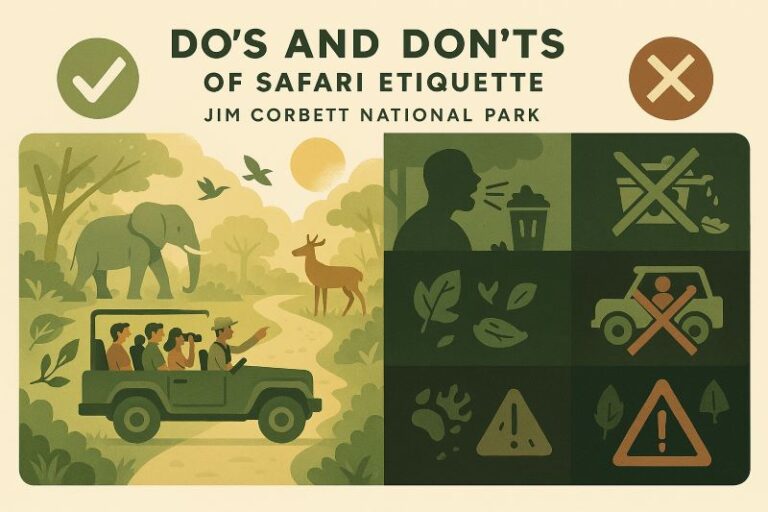
Jim Corbett National Park isn’t just another tourist spot you tick off your list. It is one of India’s most sensitive and irreplaceable ecosystems home to tigers, elephants, leopards, hundreds of bird species, and a forest system that has been thriving long before humans ever stepped into it.
Every safari jeep that enters the forest, every traveller who rides through its narrow tracks, and every choice we make inside the jungle has an impact sometimes more than we realize.
That’s why practicing responsible tourism is not just recommended here; it is absolutely essential.
When we enter Corbett, we’re not visiting a theme park.
We are stepping into a living, breathing wilderness.
We are guests and the forest always remains the host.
Whether you’re a first‑time visitor planning your dream safari or a returning traveller who already loves the jungle, here is a clear and practical guide to help you enjoy Corbett responsibly, respectfully, and sustainably.
This guide covers:
Why responsible behaviour matters
Corbett has strict regulations for a reason — noise, litter, crowding, and irresponsible driving disturb wildlife patterns. Understanding the “why” behind the rules helps travellers make better choices.
Do’s what every traveller should do inside the forest
Helpful, actionable habits that enhance your safari experience while protecting the jungle.
Don’ts What to strictly avoid during safaris
Common mistakes that many visitors make without realizing how harmful they are.
How responsible travel improves your safari
Surprisingly, following the rules not only protects the forest but actually increases your chances of better sightings and a more peaceful experience.
How you contribute to conservation as a visitor
Even simple actions like staying quiet or supporting eco-friendly lodges help preserve Corbett for future generations.
By keeping these guidelines in mind, you’re not just enjoying a trip you are actively contributing to the long-term health of one of India’s richest wildlife habitats.
And that’s something every traveller should be proud of.
Why Safari Etiquette Matters
Jim Corbett National Park isn’t just a beautiful destination it is one of India’s richest and most sensitive wildlife habitats. Every inch of this forest supports a complex web of life, from apex predators to tiny insects that keep the ecosystem balanced.
Corbett is home to:
- Tigers — elusive, powerful, and extremely sensitive to disturbance
- Leopards — stealthy and easily stressed by noise
- Elephants — intelligent, emotional animals that can feel threatened by careless tourist behavior
- 600+ bird species — from giant hornbills to delicate warblers
- Rare river species — including ghariyals, mugger crocodiles, and playful otters
- Fragile grassland & river ecosystems — where even one careless act can cause long-term impact
Because the forest is so delicate, even the smallest mistake by a tourist can ripple into real damage:
- Loud talking can scare wildlife away from their natural routes
- Littering can harm animals who accidentally ingest plastic
- Getting too close to wildlife can stress animals, provoke aggression, or disturb feeding patterns
- Leaning out of the jeep or trying to take risky photos can cause accidents
- Encouraging the driver to speed or chase sightings disrupts the entire forest rhythm
These actions don’t just spoil the experience they can alter animal behavior, push wildlife deeper into the forest, disturb breeding zones, or create long‑term ecological imbalance.
In short:
Respectful behavior keeps the forest wild.
And keeping the forest wild is the only way to enjoy it.
When travelers follow proper etiquette, several good things happen:
- Wildlife feels less threatened and behaves more naturally
- Sightings improve because animals are not alarmed
- The forest remains cleaner and healthier
- Your safari becomes quieter, richer, and more meaningful
- You help protect Corbett for future generations — including your own children
A responsible tourist doesn’t do anything extraordinary they simply remember one truth:
Inside the forest, we are visitors.
The animals are the rightful residents.
When you honor that, Corbett rewards you with an experience that is far more beautiful than any single sighting.
The Do’s: What Responsible Visitors Should Do
1. Stay Quiet and Listen to the Forest
Silence is your greatest advantage in a safari.
The forest speaks — alarm calls, bird movements, rustling leaves. Staying quiet helps guides track wildlife and reduces stress on animals.
Why it matters:
Noise can scare animals away or interrupt their natural behaviour.
2. Follow Your Guide’s Instructions (Always)
Corbett guides and drivers understand the jungle far better than we do. Their experience keeps us safe and ensures we don’t unintentionally break a rule.
Trust their judgment.
They’re not just drivers — they’re custodians of the forest.
3. Keep a Safe Distance from Wildlife
If an animal is close, admire the moment — but never pressure the driver to move nearer.
Rule of thumb:
If the animal notices you or changes behaviour because of your presence, you’re too close.
4. Stay Inside the Vehicle at All Times
Even when it feels safe or tempting to step out for a better photo — don’t.
Corbett is truly wild. Tigers, elephants, and even deer can be unpredictable.
5. Carry Back Everything You Bring In
Food wrappers, bottles, tissues — no trace should remain behind.
The forest has no waste‑management system.
What we throw becomes permanent pollution.
6. Respect Speed Limits Inside the Park
Slow driving is crucial because:
- Animals cross without warning
- Dust pollution is reduced
- Noise remains minimal
- You spot more wildlife
In Corbett, slower often equals richer experiences.
7. Use Binoculars, Not Expectations
Wildlife sighting is a game of patience.
Binoculars help you appreciate birds, deer, reptiles, and forests without disturbing them.
8. Support Ethical, Locally Run Lodges
Choosing eco‑friendly accommodations helps Corbett’s rural communities and reduces tourism pressure on sensitive zones.
The Don’ts: What Responsible Visitors Should Never Do
1. Don’t Play Music or Make Loud Conversations
This is one of the biggest rules people break.
Loud noise disrupts wildlife and spoils the experience for others.
A safari is not a road trip — it’s a nature experience.
2. Don’t Feed Animals — Ever
Feeding wildlife harms them in ways we often don’t see:
- They become dependent on humans
- Their natural behaviour changes
- They can get aggressive
- It disrupts the food chain
3. Don’t Ask Drivers to Chase Tigers
This is becoming increasingly common in tourist-heavy zones.
Chasing or blocking a tiger’s path is:
- Illegal
- Stressful for the animal
- Dangerous for everyone
- Against the very essence of conservation
We are observers, not intruders.
4. Don’t Litter — Not Even “Biodegradable” Items
Bananas, biscuits, fruit all attract animals and alter their habits.
Nothing belongs inside the forest except the forest’s own food.
5. Don’t Stand Up or Lean Out of the Jeep
This may seem harmless, but it:
- Startles animals
- Blocks views for others
- Causes unpredictable reactions
- Breaks safety protocols
Keep movements minimal.
6. Don’t Expect the Forest to Perform
The wild is not a show.
There is no guarantee of tiger sightings or dramatic moments.
If we reduce the forest to a checklist, we miss its deeper magic.
Let the experience unfold naturally.
The Responsible Tourist Mindset
A great safari is never defined by how many big cats you saw or how spectacular your photos look.
A truly meaningful safari experience is shaped by something much deeper your mindset inside the forest.
Travelers who walk away with the richest, most memorable experiences are usually those who focus on:
• How deeply they connected with nature
Not just looking for animals, but absorbing the forest’s silence, the movement of the wind through the trees, the calls of birds, and the feeling of being in a world untouched by hurry or noise. This connection stays with you long after the trip is over.
• How respectfully they behaved
Keeping quiet, avoiding sudden movements, staying seated, and giving wildlife space these small habits create a peaceful atmosphere that benefits everyone, including the animals. Good behaviour increases your chances of better sightings.
• How little impact they left behind
Responsible travellers leave nothing behind — not plastic, not food wrappers, not noise. They make sure their presence doesn’t disrupt animals, damage vegetation, or encourage unsafe driving by guides. The less you interfere, the more the forest reveals.
• How much they learned about the ecosystem
A safari is also a classroom. Every track, call, movement, and interaction teaches you something about how the forest works. Travelers who pay attention to their guide, ask questions, and observe carefully gain a deeper understanding of wildlife behaviour and conservation.
The Straightforward Truth for All Travelers
When you practice good safari etiquette, you don’t just enjoy the park —
you actively protect it.
Every responsible choice you make helps:
- Reduce stress on wildlife
- Encourage natural animal behaviour
- Maintain peaceful forest conditions
- Support sustainable tourism
- Preserve Corbett for future generations
A respectful traveller doesn’t just “take a safari.”
They become part of the conservation effort simply by behaving well.
If you want a more meaningful Corbett experience one that feels real, peaceful, and connected to nature follow good safari etiquette.
It enhances your trip and safeguards the forest’s future.
Final Thoughts: A Clear & Essential Message for Every Traveler
Jim Corbett National Park survives and thrives because visitors choose responsibility over excitement, patience over pressure, and awareness over entitlement. This forest is not just a travel destination; it is a living ecosystem that depends heavily on how we behave when we step inside its boundaries.
Every respectful action you take adds strength to the conservation efforts.
Every careless action weakens them.
If we want future generations to experience the magic we’re lucky to see today to hear the same sharp sambar alarm calls echo through the trees, to walk under the same towering Sal forests glowing in morning light, to feel the same indescribable thrill of being in the wild
then responsible tourism isn’t simply a suggestion.
It’s non‑negotiable.
Travelers play a bigger role than they realize:
- Your silence protects wildlife.
- Your patience keeps the forest peaceful.
- Your respect maintains the natural behaviour of animals.
- Your clean habits preserve fragile ecosystems.
- Your choices help define the future of Corbett.
Visiting Corbett responsibly is not just about following rules it’s about honouring a forest that has existed long before us and ensuring it continues long after we’re gone. If you truly want to enjoy Corbett the way it’s meant to be experienced, then travel gently, observe quietly, and leave nothing behind but gratitude.






