
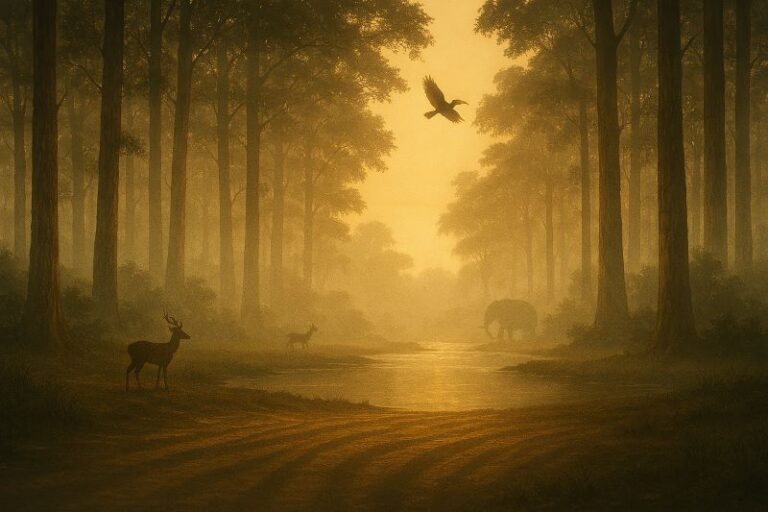
Everyone who plans a trip to Jim Corbett National Park carries the same silent hope that cinematic moment where tall, golden grass parts gently and a tiger steps out, its stripes catching the light like molten gold. It’s the postcard image we’ve all grown up with, the story we expect to come home with, and the memory we imagine will define our safari.
But here’s something most people hesitate to admit:
Many visitors do not see a tiger.
Not because the forest lacks them Corbett has one of the highest tiger densities in India but because nature doesn’t operate on our timelines.
The jungle does not perform on cue.
It does not owe us a sighting.
Corbett is wild in the truest sense unpredictable, ancient, silent, and beautifully indifferent to anyone’s expectations.
So the real question becomes far deeper and far more important.
Is Jim Corbett still worth the journey even if you don’t spot a tiger?
For me, the answer didn’t arrive in one dramatic moment.
It unfolded gradually through small, powerful experiences I didn’t even know I was seeking.
It came through the smell of damp earth as the forest woke up at dawn.
Through the rumbling warning calls of a sambar deer hidden somewhere in the distance.
Through watching sunlight drip through Sal trees like liquid gold.
Through the pause, the silence, the breath you didn’t know you were holding.
And slowly, a realisation took shape:
A Corbett safari isn’t about chasing a tiger. It’s about discovering everything else the jungle offers when you finally stop chasing.
1. The Forest Is the Real Spectacle – A Living Work of Art
Even without a tiger sighting, Jim Corbett has a way of overwhelming you the moment you enter its gates. For many travellers, this comes as a surprise but it shouldn’t. The forest here doesn’t wait for a dramatic encounter to impress you. It begins its magic from the first turn of the dusty track, from the first breath of cool, earthy air, from the first rustle in the trees that makes you lean forward instinctively.
The landscapes feel almost alive, as if the forest breathes with you.
You’ll see dense Sal forests rising like ancient guardians standing shoulder to shoulder, their tall straight trunks creating natural cathedrals of light and shadow. At sunrise, the grasslands turn golden and shimmer like fields brushed with fire. And when morning mist settles over the riverbeds, it looks as if someone draped the land in soft silver scarves. Every few minutes, the scenery changes quietly a curve in the path, a shift in the sunlight, a new canopy overhead and suddenly you’re inside a completely different world.
Travelers often expect a safari to be a sequence of big, dramatic sightings. But Corbett teaches you something subtler and far more rewarding:
the forest itself is the main attraction.
This isn’t a curated or carefully manicured park designed for tourist convenience. Nothing here is staged or predictable. Corbett is one of India’s oldest, wildest, most biodiversity‑rich forests a living, breathing ecosystem where every plant, bird, and animal follows rhythms set by nature alone.
It’s a place that Jim Corbett himself walked with deep reverence, patience, and respect not as a tourist, but as a listener to the forest’s stories. When you step into these woods, you begin to understand why he dedicated his life to protecting them.
And that’s when the realization hits you:
Corbett’s real magic isn’t tied to whether a tiger reveals itself.
It lies in the forest’s quiet decision about what to show you and what to hold back.
Travelers who come with rigid expectations often miss this. But those who keep their eyes open, who lean into the silence, who follow the play of light and the sound of wind through Sal leaves they experience a deeper, richer safari than any 10‑second tiger sighting could ever offer.
Because here’s the simple, honest truth:
Corbett gives you what you’re ready to appreciate, not what you demand.
And once you understand that, the forest reveals its beauty in ways you didn’t even know to look for.
2. Wildlife Beyond Tigers – A Treasure Many Overlook
A safari without a tiger isn’t a disappointment.
In many ways, it’s a revelation especially in a place like Jim Corbett.
Most travellers arrive with one overriding expectation: the tiger. But what many don’t realise is just how incredibly rich, layered, and alive Corbett is, even without the stripes. When you allow yourself to look beyond the “main event,” you discover a forest that rewards patience, curiosity, and presence in dozens of unexpected ways.
Here’s what most people underestimate and what every traveller should know before entering Corbett:
• Great herds of elephants: You might see an entire family of elephants moving together with the slow, silent power of a river. Their presence is grounding one of the most humbling sights the forest offers. Watching a mother guide her calf across the road is often more emotional than any tiger sighting.
• Otters in the Ramganga River: If you’re lucky, you’ll spot otters skipping across the surface of the water, diving in and out like playful spirits. These moments are rare in most Indian forests, but Corbett still protects these beautiful, energetic creatures.
• Ghariyals sunning on rocks: These ancient-looking reptiles bask in neat lines on the riverbanks, looking almost like prehistoric sculptures placed deliberately by time. For travellers interested in unique wildlife, this alone makes Corbett special.
• Leopards the silent rulers: Far more elusive than tigers, leopards melt into the shadows with unbelievable stealth. You might never see one directly, but your guide might show you fresh tracks or warn calls a reminder that the forest is alive even when you don’t see the predator.
• Deer everywhere, in all sizes: From the graceful spotted deer to the solid and regal sambar, the diversity is stunning. Seeing them graze calmly in the open grasslands adds beauty and movement to every safari.
• Birds over 600 species: This is something most travellers are truly surprised by. Corbett is one of India’s top birding destinations. From hornbills and eagles to tiny colourful species you’ve never heard of, the sky is constantly filled with calls, flashes of wings, and movement.
If you enjoy photography, you’ll never run out of subjects.
Why This Matters for Travelers
A lot of people rush through safaris searching only for the tiger. But when you do that, you miss the forest’s actual gifts the moments that linger long after your trip ends.
Sometimes, the forest offers a scene so simple yet so beautiful an elephant calf splashing in a stream, a kingfisher diving for its catch, or a herd of deer standing alert at sunrise that it stays in your mind far longer than a quick glimpse of a tiger disappearing into the bushes.
And that’s the truth seasoned travellers eventually learn.
The magic of Corbett lies in everything you see
not just the thing you hope to see.
It’s a place that teaches you to observe, listen, and appreciate the wild in its most natural form.
When you shift your expectations, Corbett opens itself in ways you never imagined — making your trip richer, calmer, and far more memorable.
3. A Tiger Is Chance – the Forest Experience Is Certain
Safaris aren’t tiger shows.
They are windows into a vast, breathing ecosystem a world that reveals itself slowly, layer by layer, if you’re willing to look beyond the obvious.
The real joy of Corbett comes from the moments in between:
• Spotting fresh pugmarks
The thrill of leaning over soft mud and seeing a perfect imprint a silent reminder that a tiger passed there moments or minutes before. It’s like reading a chapter of a story written in footprints.
• Hearing sambar alarm calls
Their sharp echoes travel through the forest like natural sirens, signalling that a predator is nearby. Even if you don’t see the tiger, the forest’s tension and communication feel electric.
• Watching your guide read the jungle
Experienced guides interpret sounds, wind direction, bird calls, and even the mood of the forest. For travelers, this is one of the most fascinating parts it feels like watching someone read a moving, living story that only they can understand.
• Feeling the sunlight shift
As the jeep moves deeper into the woods, the bright morning sun softens into a cool shade, carrying the smell of damp leaves and wild earth. These subtle transitions remind you that every corner of the forest has its own atmosphere.
In these quiet, powerful moments, you begin to understand something important:
The forest is speaking through sounds, signs, and silence.
And without even trying, you start listening.
Tiger or no tiger, the wild wraps itself around you in a way that stays long after your safari ends.
That connection that feeling of being part of something larger than yourself is the real prize.
4. Corbett Teaches You Patience – And You Don’t Even Notice It
We live in a world where everything arrives instantly food at our doorstep, messages within seconds, entertainment on demand. Almost nothing requires waiting anymore.
But Corbett is the opposite.
The moment you enter the forest, something inside you begins to slow down. Your heartbeat softens. Your mind quiets. It gently pulls you out of your everyday rush and places you in a world where time feels older, calmer, and more honest.
Corbett teaches you to do things we rarely practice in our modern lives:
• Watch
To notice the slight movement behind a bush, the rustle of leaves, or a deer lifting its head.
• Wait
To let the forest unfold at its own pace without trying to force a moment into existence.
• Listen
Not just to the sounds of birds and animals, but to the deep silence between them something we often forget even exists.
• Breathe
To take in the fresh air, the damp smell of the earth, and the stillness that only an ancient forest can offer.
Slowly, without you even realizing it, something changes.
You stop checking your watch.
You stop asking “How much time is left?”
Instead, your eyes start drifting to the trees, the light, the movement of the wind through the Sal leaves.
This shift in your mind is profoundly healing a sort of quiet reset that no sighting, not even a tiger, can guarantee.
But the forest gives it to you effortlessly, simply by being what it is.
5. The Human Side: Guides, Stories & Forest Wisdom
Talk to any seasoned guide in Jim Corbett, and you’ll discover that their stories are as deep and layered as the forest itself. These aren’t just guides they are people who have spent years, sometimes decades, walking the same trails, listening to the same silence, and learning the rhythms of the jungle in a way few outsiders ever will.
Their experiences are shaped by encounters both breath-taking and tense: the heart‑stopping silence before a tiger emerges, the unexpected appearance of a leopard slipping through the shadows, narrow escapes during elephant musth, and the subtle yet fascinating seasonal changes that dictate how animals behave.
Every time they speak, you feel the weight of their relationship with the forest.
Their knowledge becomes the heartbeat of your safari:
• How they decode a tiger’s movement
A single pugmark, a broken branch, or a sudden alarm call can tell them the direction, speed, and even the mood of the tiger. Watching them analyse these clues is like watching a detective at work quiet, sharp, intuitive.
• How the forest transforms with each season
They know how winter fog changes animal visibility, how summer heat pushes wildlife toward the river, and how monsoons reshape the forest floor. This insight helps travellers understand why every season offers a different safari experience.
• How birds communicate danger
Guides can identify bird calls instantly whether it’s a langur warning of a predator below or a drongo alerting others to movement. These signals help them trace what the human eye might miss.
• How the jungle heals itself
After storms, droughts, or forest fires, guides witness first-hand how nature repairs, regrows, and rebalances. Their stories show travellers that the forest is not just a home for wildlife but a resilient, self‑sustaining world.
By the time they finish speaking, you realize something profound:
The forest isn’t just wildlife.
Its wisdom, patience, memory, and legacy passed down through those who understand it best.
You return from the safari not just with photographs, but with stories you didn’t know you needed stories that stay with you far longer than a momentary sighting.
6. Tiger Sightings Happen When You Stop Chasing Them
Ask those who visit Corbett often, and you’ll hear a surprisingly consistent truth tiger sightings usually happen when you’re not looking for them. They arrive like moments of grace, quiet and unexpected, more like a blessing than a reward you earn. And perhaps that’s what makes them so unforgettable.
If it happens, its magic pure and electrifying.
But if it doesn’t, your trip is far from empty.
Corbett ensures you leave with gifts far more meaningful:
• Calmness
The kind that settles into you slowly, as the forest’s stillness replaces the noise you carry from your everyday life.
• Fresh air
Crisp, cool, untouched the type of air that feels like a reset button for your mind and body.
• A deeper respect for nature
You begin to understand the quiet intelligence of the jungle how every animal, bird, and tree plays a role in the forest’s rhythm.
• Landscapes that feel like paintings
Golden grasslands at sunrise, mist floating above the river, Sal forests glowing in slanted light scenes so stunning they stay with you long after you return home.
• Wildlife moments that genuinely surprise you
An elephant herd crossing your path, a kingfisher diving into the water, a sudden alarm call echoing through the trees these moments are raw, real, and unforgettable.
• A quiet awe that follows you home
A feeling you can’t quite describe, but one that reminds you that you were a guest in a world much older, wiser, and more balanced than your own.
In the end, you realize something profound:
Corbett doesn’t just give you experiences.
It gives you what you’re ready to appreciate.
And that understanding stays with you longer than any single sighting ever could.
So… is Jim Corbett worth it even if you don’t see a tiger?
Absolutely. Completely. Unquestionably — yes.
If you are planning a trip and wondering whether it will still feel meaningful without the famous tiger moment, here is the simplest and most honest recommendation:
Go for the forest itself.
Corbett’s landscapes the Sal forests, the misty riverbeds, the golden grasslands are reason enough to visit. The wilderness here feels ancient and untouched, something you rarely experience elsewhere.
Go for the silence and the stories hidden in the trees.
There is a kind of calm in Corbett that is impossible to describe until you feel it the soft rustle of leaves, the distant call of a bird, the quiet that makes you breathe differently.
Go for the unexpected moments.
A herd of elephants crossing your path.
A kingfisher flashing blue above the river.
A deer standing perfectly still at sunrise.
These are often the memories travelers cherish the most.
Go because the jungle reminds you how to feel again.
Corbett slows you down.
It grounds you.
It reconnects you to nature in a way no photograph or checklist ever could.
A tiger, if it appears, is a beautiful gift a moment of pure magic.
But it is not the purpose of the trip.
The true value of Corbett is that it teaches you something many of us forget:
Nature doesn’t follow our checklist.
It reveals itself in its own time and that unpredictability is its greatest beauty.
If you travel with an open heart and flexible expectations, Corbett will always reward you sometimes with a tiger, but always with something deeper.






