
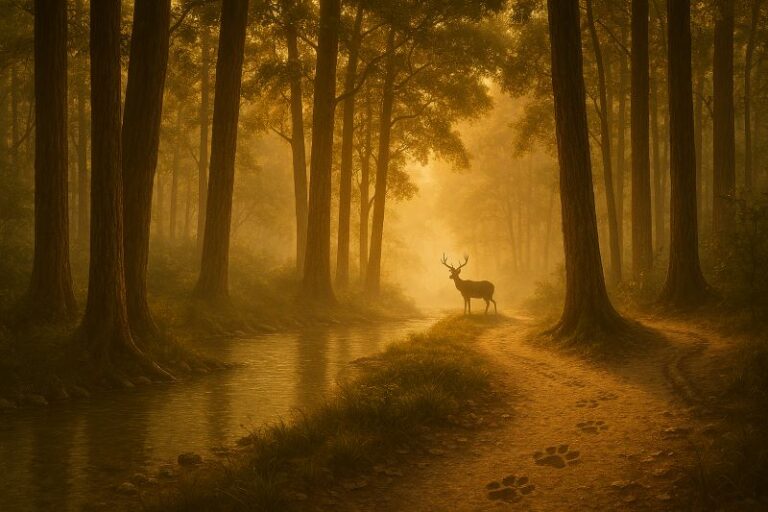
A Reflective Journey through Jim Corbett’s Wild Heart
There is a moment in every forest especially in a wilderness as ancient, vast, and intuitive as Jim Corbett National Park when the constant chatter in your mind begins to soften. It doesn’t vanish the instant you cross the park gates, and it certainly doesn’t obey your schedule. Instead, it arrives gradually, gently, almost shyly, the way the first winter sunlight filters through the towering sal canopy. And before you even realise it, the jungle has already begun its quiet lessons.
During one of our recent safaris in Jim Corbett, we found ourselves waiting near a serene curve along the Ramganga riverbed, that lifeline of the forest. Our guide had picked up a distant alarm call—a sambar deer’s sharp, anxious bark echoing through the sal trees signaling the possible presence of a predator. We halted the gypsy, hearts hopeful, senses sharpened, excitement mingled with a familiar impatience. Ten minutes passed. Then twenty. The jungle remained still, unmoving, untouched by our anticipation.
But in that extended, almost meditative stillness, something began to shift.
The forest was no longer just a setting. It was speaking, teaching, reminding us that a safari is not merely a search for a tiger’s stripes it is an invitation to slow down, to observe, and to reconnect with nature’s slower rhythm.
Learning to Wait—the Forest’s First Lesson
In our daily, fast‑paced lives, we’re conditioned to expect everything instantly. Notifications appear within seconds, deliveries promise “same‑day,” and decisions are often demanded on the spot. We operate in a world built around immediacy.
But inside the jungle especially a forest as wise and unhurried as Jim Corbett National Park the concept of “now” simply does not exist. Here, time stretches, breathes, and moves according to the ancient rhythm of nature.
That morning, as we waited by the Ramganga riverbed, the forest offered us one of its most powerful lessons: patience is not passive. It is a state of alert presence, a quiet readiness that heightens your awareness instead of dulling it.
Around us, the signs of this mindful patience were everywhere.
- A langur, perched high on a distant branch, scanned the forest floor with unwavering concentration, each subtle movement of its head deliberate and purposeful.
- A vibrant kingfisher, frozen on a smooth river rock, allowed its turquoise feathers to shimmer only when the light caught them just right.
- Even the forest breeze seemed to slow down, pausing mid‑whisper, as if the entire ecosystem was locked in a gentle, shared inhale.
Nothing here rushed. Nothing here pushed forward without intention. Everything waited calmly, attentively, respectfully.
And within that waiting, we sensed a deeper meaning.
It was then we realised: patience isn’t about doing nothing. It’s about being entirely present as you wait.
The jungle wasn’t asking us to sit still it was inviting us to see more, feel more, and understand more.
Stillness Isn’t Emptiness—it’s Awareness
Stillness in the jungle is rarely truly silent. In fact, the deeper you listen, the more alive it becomes. The forest is a world of micro‑movements each one subtle yet significant. You hear the delicate crackle of dry leaves under a cheetal’s cautious step, the soft rustle of a bird shifting from one branch to another, the steady murmur of the Ramganga River nudging against ancient stones.
You may not always spot a tiger during a Jim Corbett safari, but if you pay attention, the forest whispers its presence through signs, sounds, and shifting energy.
That morning, as we sat in complete stillness, something awakened within us. Our senses, dulled by the hurried pace of everyday life, began to sharpen.
- Patterns emerged in the tall, sunlit grasses details we had walked past countless times without noticing.
- We learned to distinguish between ordinary bird calls and the sharp urgency of a genuine warning call.
- We watched the sunlight move gracefully across the forest floor, painting slow‑moving golden patches that shifted with the canopy above.
Stillness wasn’t empty. It wasn’t stagnant.
It was a powerful recalibration a reset that only nature can offer.
In that quiet, the forest taught us something essential:
When you finally stop rushing, the world begins to reveal the details you were once too distracted to see.
The Jungle’s Wisdom Mirrors Life
Every safari is, in many ways, a metaphor for life. But Jim Corbett National Park has a unique way of revealing life’s deepest truths without ever speaking a single word. Its silence teaches, its stillness reflects, and its wilderness offers wisdom that stays with you long after the safari ends.
Here’s what the forest quietly whispered to us that day.
1. Not every sign means you must move.
In the modern world, we’re conditioned to react instantly an alert, a message, a signal. But in the jungle, not every sound or movement demands action. Sometimes, the wisest choice is to stay still, listen, and allow clarity to form naturally.
The forest reminds you that inaction can be intentional, a conscious pause rather than hesitation.
2. What you seek won’t always appear—yet the journey is still worthwhile.
We waited for a tiger that never emerged from the sal trees. And yet, we didn’t feel disappointed.
Instead, we left with something far more valuable: perspective. The jungle teaches that life rarely unfolds exactly as we expect, but the experience every sound, every breath of wind, every moment of anticipation holds its own meaning.
3. Presence is more powerful than speed.
The jungle does not reward rushing. Animals survive through awareness, not haste.
A safari in Jim Corbett reminds you that slowing down heightens your senses and deepens your experience. Whether in the forest or in life, being fully present allows you to notice what speed makes you miss.
4. Nature is not a performance; it’s an experience.
We often treat safaris like a checklist—tiger ✔️ elephant ✔️ kingfisher ✔️.
But the forest is not on display for us. It unfolds in its own rhythm, its own mystery.
The real magic lies in observing nature on its own terms: the movement of shadows, the alarm calls echoing across the valley, the quiet language of the wild that speaks without words.
A Moment to Carry Home
Eventually, the sambar’s urgent alarm call softened and disappeared into the forest’s natural hum. The tension in the air melted away, and the jungle slowly returned to its calm, rhythmic breathing. Our guide glanced back at us with a knowing smile and gently signaled that the tiger had likely chosen a different path another trail deep within the sal forest that we could not see, but the jungle understood.
We moved forward on our Jim Corbett safari, yet a part of us remained rooted in that powerful pause anchored in the quiet moment of waiting, listening, and learning. And strangely, the absence of a tiger sighting didn’t feel disappointing. It didn’t feel like a missed opportunity.
Instead, it felt like a conversation with the forest a silent exchange of wisdom that reminded us of a timeless truth. The jungle always gives you what you need, not necessarily what you came looking for.
In that moment, we realised that Corbett is more than a destination for wildlife enthusiasts. It is a living teacher, offering perspective, grounding, and an unspoken connection with nature. Sometimes the greatest gift of the jungle is not the sighting of a majestic tiger, but the insight it leaves within you the stillness, the patience, the understanding that nature unfolds in its own graceful rhythm.
Why We Keep Returning to Corbett
Because in the jungle, every visit becomes a lesson one written not in words, but in wind, light, and silence. Every pause becomes a message. Every stretch of waiting becomes a teacher with its own quiet authority.
Jim Corbett National Park is not just a forest to explore; it is a meditation you step into. A living, breathing sanctuary that gently reminds you that life does not bend to our hurried timelines. Nature moves at its own pace mysterious, ancient, and magnificently unhurried.
Out here, among the sal trees and riverbeds of Corbett, you begin to understand that the world doesn’t always need your speed. Sometimes, it needs your stillness. If we allow ourselves to slow down—to listen, to observe, to simply be we realize something profound:
The world around us has been speaking all along.
And so has the world within us.
The jungle doesn’t just show you wildlife; it reveals your own inner quiet. It teaches you patience, presence, and perspective lessons we often miss in the noise of everyday life. Corbett becomes more than a destination; it becomes a reminder that the most powerful wisdom emerges when we embrace nature’s rhythm instead of resisting it.






